
 Back to Home Page


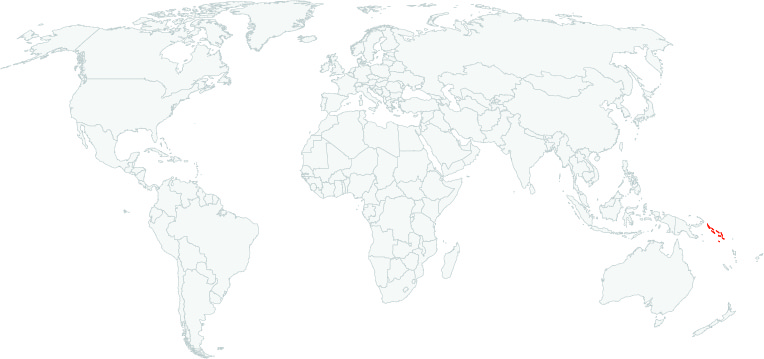
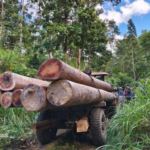
- Governance challenges and reports of corruption in the Solomon Islands’ timber sector are well publicized.
- Illegal logging is widespread and there are significant risks associated with timber sourced from natural forests on customary land and from large-scale plantations.
- Forest laws are not well-enforced; operators found to be operating illegally rarely are fined or lose their licenses.
- Direct exports to U.S. and EU markets are low while exports of logs to China have rapidly risen. Most of the concessions in the country are owned and operated by Asian companies from China, Singapore, Malaysia, and India.
- NGO reports have documented cases of high-risk timber sourced from the Solomon Islands being used in Chinese-manufactured products that are likely entering European and U.S. markets.
- New reference material has been collected that will support enforcement officials to be able to identify timber harvested in the Solomon Islands.
Read more by downloading the Solomon Islands Timber Legality Risk Dashboard here.
Nearly 783,000 cubic metres a year reach Australia through Chinese processing provinces alone, the largest single elevated-risk pathway in the report, with country of origin modelled province by province from General Administration of Customs statistics because provenance is not tracked once logs enter Chinese mills. Bilateral trade from Indonesia and Malaysia adds more than 310,000 cubic metres apiece, with Russia, Vietnam, Papua New Guinea, and Africa filling out a total of 1.95 million cubic metres of elevated-risk trade. Cameroon at 28,000 cubic metres a year, the Republic of the Congo at 22,600, Equatorial Guinea at 21,600, and Gabon at 14,900 head the African detail inside that total. Mozambique, Uganda, the Democratic Republic of the Congo, and eight further nations extend a Congo Basin and East African supply line that few Australian buyers would connect to their doors and decking.
No category carries more exposure than wood furniture, where 92 per cent of imports come from elevated-risk origins, and China alone accounts for 68 per cent. Engineered wood products follow at 68 per cent elevated-risk, with 43 per cent of the category from China, a supply chain reported separately today.
Builders’ carpentry reaches 70 per cent on the same measure, split mainly between China, Indonesia, and Malaysia, while 68 per cent of sawn hardwood imports carry the banding, with Malaysia the largest single origin. Sawn softwood is the exception, with 95 per cent of the category supplied by New Zealand, North America, and Western Europe, the only product line still dominated by low-risk trade.
“Even though importers fully meet their due diligence requirements,” the authors find, fraud in international supply chains can still put illegal timber, and wood from legal deforestation and plantation clearing, on the Australian market under the Illegal Logging Prohibition Act 2012.
Certified wood offers no clean exit either, with the global certified supply finite, so rising Australian demand for certified imports pushes other buyers onto uncertified wood. The paperwork gap is measurable: Source Certain testing released under freedom of information found that 37 of 74 sampled imported products were not the stated origin, species, or genus, or both.

Prime Minister [PM] Hon. Matthew Wale on Tuesday received a courtesy visit from Temotu Province Premier Stanley Tehiahua and his executive.
The Premier also raised concerns over illegal logging and mining activities in the province. He shared the challenges faced by the provincial government in effectively enforcing its regulations. In response, Prime Minister Wale acknowledged the Premier and his executive for the visit and assured them that his government remained accessible to the provinces.
The Prime Minister directed Premier Tehiahua to formally document and submit details of the alleged illegal logging and mining activities to his office.
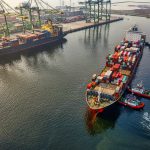
Reduced harvesting in Australia’s native forests is driving timber demand offshore to countries with a high risk of illegal logging and deforestation, a pattern that has pushed the nation’s overseas harvest footprint far beyond the domestic one it is meant to replace.
According to Dr Venn, the volume of timber cut in Australia’s native forests has fallen by 75 per cent over the past three decades, with local hardwoods used for floors, windows and joinery displaced by a surge of tropical timber from countries with high risks of deforestation, degradation and timber trafficking. “Imports make up 46 per cent of timber traded in Australia,” Dr Venn told the dinner, a rise from just 24 per cent in 1996.
And of those imports, Dr Venn revealed that about half originate in countries rated as high-risk for illegal harvesting, deforestation, and forest degradation, with large volumes routed through China and traced back to PNG, the Solomon Islands, Russia, South and Central America, and Southeast Asia.
Researchers at University of Queensland state that for every 100,000 cubic metres cut from Australia’s native forest production, imports rise by 81,300 cubic metres in the long run, and 86.8 per cent of the replacement wood came from elevated-risk nations.
Wood routed through Chinese processing provinces has reached nearly 783,000 cubic metres a year, the largest single elevated-risk pathway in the analysis, with China now supplying 30 per cent of Australia’s solid wood imports.
This report was commissioned by the North East NSW, South East NSW, South & Central Queensland, North Queensland and Tasmanian Regional Forestry Hubs with funding from the Australian Government, Department of Agriculture, Fisheries and Forestry.

A new report by RimbaWatch signals how Papua New Guinea’s forests are being systematically targeted by Malaysian-linked logging companies, which control 97% of all Forest Clearing Authority (FCA) licenses and routinely misuse them to carry out large-scale timber extraction rather than genuine agricultural development. These firms—many tied to powerful Sarawak timber dynasties—operate across nearly two million hectares, often without securing free, prior and informed consent from customary landowners and frequently engaging in practices linked to fraud, intimidation, and human rights abuses. Case studies across multiple provinces show a consistent pattern: promised plantations never materialize, while companies aggressively log high-value timber, sometimes with the support of police forces they allegedly house and feed. The result is widespread illegal deforestation, community harm, and a deeply entrenched system of exploitation that mirrors earlier patterns of forest destruction in Malaysia

The Solomon Islands Timber Processors and Exporters Association (SITPEA), highlighted growing momentum in certification within the region.
Last month, three of SITPEA’s 17 member companies underwent external audits under PEFC’s Chain of Custody standard. And whilst final results are pending, initial feedback has been overwhelmingly positive. SITPEA is now preparing to expand certification across its network, aiming to build a transparent and internationally trusted supply chain.

The Solomon Islands is using timber and bamboo processing to strengthen ties with China under a series of new programmes.
In Solomon Islands, forest coverage is around 90%, and most of the country’s revenue comes from logging, with limited development of downstream products. While logging remains the Solomon Islands’ largest export, unsustainable practices have raised concerns among local communities

China is using forestry, bamboo, and high-value timber processing to strengthen ties with the Solomon Islands—the latest example of Belt and Road timber, forestry, and bamboo diplomacy. It comes as eleven forestry officers are in China for a two-month intensive training programme as part of the Solomon Islands Seminar on Forest Utilisation and Downstream Processing, a programme set up by the Chinese to build Solomon’s downstream processing capacity.
Wood Central understands that the programme’s goal is to reduce the negative environmental impacts of logging, increase revenues from forest production to benefit local communities, and develop a regulatory framework that promotes a greater balance between utilising forests for both logging and non-logging purposes.
THE Value Added Timber Association (VATA) Enterprises Limited is partnering with Australia to promote sustainable timber production in Solomon Islands.
Under the Solomon Islands-Australia partnership, VATA will support smallholder farmers to harvest, mill, and export plantation timber to Australia and New Zealand.
IMF staff expects growth at 2.5 percent in 2024 and 2.8 percent in 2025. Medium-term growth prospects appear moderate. Comprehensive and sustained reforms are needed to enhance potential growth, including better transportation in rural areas and addressing governance weaknesses in the minerals and forestry sectors.
Medium-term growth prospects appear moderate, with anticipated growth of around 3 percent, constrained by declining logging activity and the undiversified economic base with weak governance. Both fiscal and current account deficits are expected to persist in the medium term, driven by declining log exports and the ongoing and anticipated infrastructure projects.

This article summarizes the science behind World Forest ID, but also gives a glimpse at the support provided by Australia, work now being done by IKEA (which used to source extensively from Russia and Belarus), and a recent Belgian investigation into illegally sourced wood imports.
Also reported here: Keeping Sanctioned Russian Timber Out of the EU Is Tricky. This Nonprofit Has a Solution. – WSJ

A 2023 UN report, found the “sale” of girls to foreign workers in Solomon Islands logging sector for the purpose of sex and marriage was often arranged by parents, other family members and young male peers.
The report said the social acceptance of “bride price” was being distorted to facilitate what it called “commercial child sexual exploitation and human trafficking”.
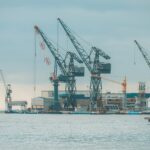
The Pacific Islands are working towards a new Pan-Pacific Standard for Sustainable Forest Management. The new standard could include Fiji, Papua New Guinea, the Solomon Islands, Tonga and Vanuatu.
the new standard would greatly assist Trans-Tasman importers and provide a “green lane” for tropical timbers, most importantly demonstrating sustainable forest management. In New Zealand, the new standard could significantly assist in monitoring certified products imported into and sold through NZ building and construction networks.
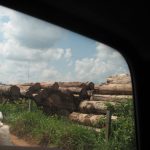
A report on the effect of industrial logging on the lives of Solomon Islanders calls for urgent action to prevent further environmental damage and generational harm in local communities.
The report, The Impacts of Logging on Human Rights in Solomon Islands, from Franciscans International, found that logging continued to blight the island communities, and was having a negative impact on their way of life. This ranged from polluting water supplies and destroying crops to damaging the lives of young people and causing conflict.

UN Report on economic development notes that SI is heavily reliant on the logging industry which contributes 20 per cent to domestic revenue and over 70 percent of exports. However, the resource has been over-exploited and is facing depletion. The
Government’s policy for sustainability would imply a halving of logging activity by 2023.
Other notable export commodities include palm oil (3 per cent) and coconut oil
(1.8 per cent). While the current high price for timber is offsetting losses in export volume and the balance
on trade in goods has not yet been impacted, new sources of growth are needed to sustain the economy
and preserve the balance of payments in the longer term.
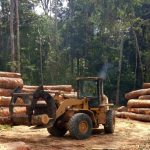
The Solomon Islands in the Pacific Region is endowed with idyllic beaches and vast biodiverse rainforests. But beneath its picture-perfect scenery lurks a troubled reality. The country already bears the brunt of climate change impacts such as rising sea levels and frequent typhoons of escalating intensity.

Guardian analysis of trade data has revealed that China received more than half the total tonnes of seafood, wood and minerals exported from the region in 2019, a haul worth $3.3bn that has been described by experts as “staggering in magnitude”.
The country’s mass extraction of resources comes as China has deepened its connections with governments across the region, amid a soft power push that sees it rivalling the influence of the US and Australia in the Pacific.
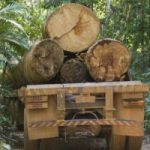
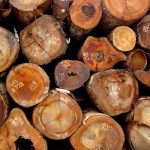
When Malaysian logger Richard Kong Sing Ngea pleaded guilty in December 2020 to the illegal harvesting of Tubi trees in Solomons’ Isabel Province, tribal leader Wilson Tohidi was thrilled. Ngea’s admittance of guilt, Tohidi believes, should prompt the Solomon Islands Government to seize the illegally felled logs and return them to landowners.
In November 2021, Honiara, the capital of the Solomon Islands, was wracked by riots that left three people dead and the city’s Chinatown in ashes. The unrest was stoked by the prime minister’s decision to end diplomatic ties with Taiwan and instead side with Beijing, stirring up anti-Chinese sentiment, as well as tensions between Guadalcanal province, where the capital is located, and Malaita, the country’s most-populous province but also one of its least-developed.
 Key Resources

 Methodology
 Data Tools
Click here to access the Global Illegal Logging and Associated Trade (ILAT) Risk assessment tool and to download the Forest Trends User Guide describing the functionality of the ILAT Risk Data Tool.
Click here to access the Cattle Data Tool.
 Export Restrictions
 Trending