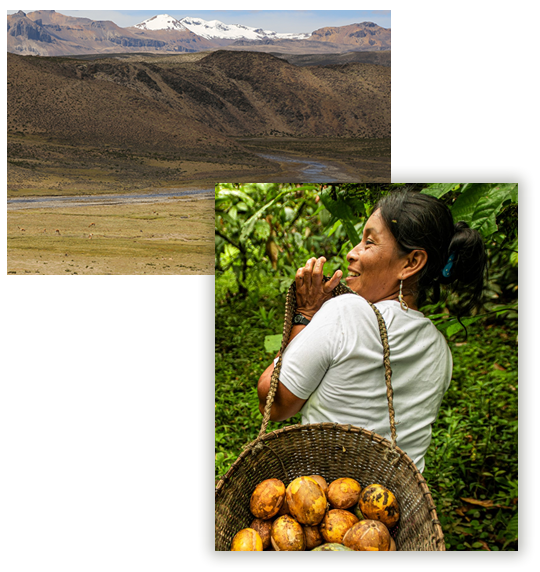
Together with partners around the world, Forest Trends pioneers innovative finance for conservation, promoting healthy forests, sustainable agriculture, clean water, robust climate action, biodiverse landscapes, and strong communities.
Our programs and initiatives publish timely research, bring together diverse actors, and apply these approaches to make a difference on the ground, often blazing trails for bold and far-reaching policies in the process.
Flagship Work
News From Ecosystem Marketplace
Forest Trends protects critical ecosystems through creative environmental finance, markets, supply chains, and other incentive mechanisms. We build diverse coalitions with governments, local and indigenous communities, and business to ensure that all stakeholders are engaged and benefit from conservation.




MacGregor Ranch was established in 1873, before Colorado was a state. Bill Van Horn has spent his life thinking about what it means to care for a place like that and pass it on.“I view it as a window into the past.”Tomorrow, Bill's full story in Protect What Matters.What is a place in Colorado that carries history for you?#ProtectWhatMatters
Under 30 and passionate about nature? We want to hear from you.At Forest Trends, we’re thinking about how to better connect with the next generation of nature advocates. Instead of guessing what matters to you, we’re asking.Take our quick, anonymous 2-minute survey to help shape how we engage with younger generations in the years ahead.As a thank you, you can opt in to receive survey findings and enter a drawing for a 30-minute career conversation with someone on our team working in conservation finance.Your perspective can help shape what comes next.Take the survey: bit.ly/YoungAdvocatesSurvey
Three weeks ago, we asked what matters to you. You did not hold back.A river you learned to fish in. A trail your dad walked you up. The view from a kitchen window. A town you never want to see threatened by fire.Swipe through a few of your answers. They are better than anything we could have written for you.Didn't make this round? Finish the sentence below: What matters to me is _____.#ProtectWhatMatters
Here is the part that surprised us: in 2026 research informing this campaign, 80% of Westerners surveyed supported work to reduce wildfire damage. At the same time, 65% said they had not heard a clear plan for doing it.That gap matters. Support for the goal is broad, but the work itself is still unfamiliar to a lot of people.That is one reason we made Protect What Matters: to show what wildfire resilience looks like through people already doing it.See the film at bit.ly/ProtectWhatMatters_Film on our YouTube page.#ProtectWhatMatters
Zach Miller makes a living doing hard things for a very long time. His philosophy is pretty simple: do the work before you need it.He thinks about wildfire the same way.“It's just a lot easier to do some work on the front end and be anticipating things, as opposed to waiting for problems and then reacting.”Thinning crowded stands, clearing hazardous fuels, taking care of the place now so it is better prepared later. For Zach, it is not that different from training.His full story is live. Watch at bit.ly/PWM_Zach on our YouTube page. #ProtectWhatMatters
We have planted well over one million trees with Arbor Day Foundation and local communities in Brazil's Atlantic Rainforest since 2023 as part of the first phase of the Arboredo Project. The Arboredo Project: - Replanted an area roughly 3.7 times the size of the City of London (1,089 hectares) in the Ribeira and Paraíba Valleys of São Paulo State - Directly engaged 379 families - Mobilized 40 organizations and community groups - Supported four community nurseries, and - Created 110 job opportunities linked to forest recovery and food production - Channeled more than 1.7 million Brazilian Reales through the local restoration economy through labor, the purchase of native seeds and seedlings, tools needed for planting, and consultation of local experts Implementation on the ground was led by local cooperative Cooperativa Para A Bioeconomia (COOBIO) in the Ribeira Valley and Akarui in the Paraíba Valley, both groups deeply rooted in their territories and the communities they work with. The next proposed step for this work is the Arboredo EntreVales Project, which would connect restoration efforts across four landscapes and translate experience gained during the Arboredo Project into a larger-scale strategy to strengthen community and landscape resilience in the region. For more key outcomes, see the full press release: www.forest-trends.org/pressroom/release-forest-trends-and-arbor-day-foundation-complete-one-milli...
Zach Miller has run some of the hardest races in the world. But the place that shaped him most is outside his front door.Zach lived at Barr Camp, halfway up Pikes Peak, with no road in.“Colorado's mountains and forests are definitive of who I am as a person.”Tomorrow, Zach's full story in Protect What Matters.What is a place that became part of who you are?#ProtectWhatMatters
Climate change is no longer a distant risk. Between increasingly severe wildfires and devastating floods worldwide, it is reshaping daily life, community safety, and local economies. Our Founding President and CEO, Michael Jenkins, sat down to discuss what we miss when we approach environmental challenges in isolation. Ecosystems are not siloed. They are deeply interconnected, and to protect and restore them successfully, our solutions shouldn’t be siloed either. While Michael is not the most active on social media, you can sign up to receive more exclusive updates from him at bit.ly/FT-newsletters And if you appreciate this work, consider becoming a donor at bit.ly/FT-Donors
Fire is not new to Colorado's forests. But not every fire burns the same way, and the condition of a forest matters.At Cal-Wood, the work happening now is not about keeping fire out forever. It is about helping the forest and the people who depend on it be better prepared when fire returns.Rafael puts it simply: prepare for the next one, not the last one. Watch his story at bit.ly/PWM_Rafael on our YouTube page.#ProtectWhatMatters
Rafael Salgado stood on a ridge and watched his outdoor classroom burn. Then he went back to work.Cal-Wood has been getting kids into the mountains since 1982. In 2020, fire burned roughly 600 acres of the property. What came next is the part people do not always see: clearing hazardous fuels, thinning where needed, helping the forest recover and preparing for the next fire instead of waiting for it.“My legacy will be to leave Cal-Wood ready for the next 40, 50 years.”Rafael's full story is live. Watch it at bit.ly/PWM_Rafael on our YouTube page. #ProtectWhatMatters


Forests
Sep 11, 2026
Communities
Sep 2, 2026

Agriculture
Jun 17, 2026
Support Us
Our natural resources are at great peril because of an economic system that does not value standing forests and their services. Forest Trends has developed strategic approaches to address this problem – but we can only succeed with your support.
Email Signup
Subscribe to any of Forest Trends’ mailing lists to keep up with the news, publications, and events that interest you.